
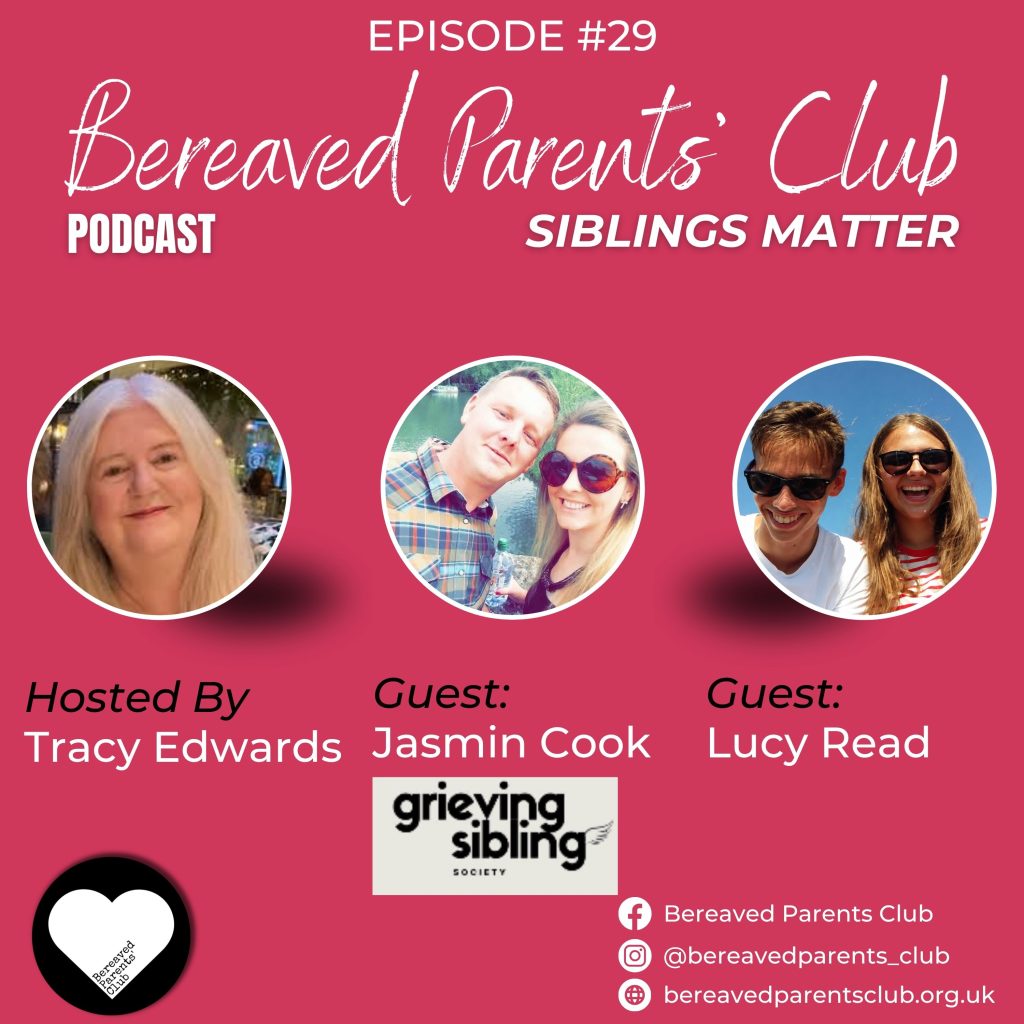
Episode Guests -Jasmin Cook & Lucy Read
We are delighted to have chatted with Jasmin and Lucy for this very special episode Siblings Matter which we have released in support of bereaved siblings and familys during Sibling Loss Awareness Month.
We discuss sibling bereavement with Jasmin and Lucy, who share the stories of their brothers, Gavin and Michael.
We discuss ways of remembering their brothers. Lucy and her family have taken part in fundraising events and running challenges, and have benches dedicated to Michael in places that mattered to him. Jasmin completed a fundraising challenge for stroke awareness, and her family gathers at a bench in a place associated with Gavin. She also describes forming the Grieving Siblings Society with two other bereaved siblings to support people facing similar loss.


Summary:
We speak with Jasmin and Lucy about losing their brothers, Gavin and Michael, and how bereavement affected their work, friendships and family relationships. We discuss the limited support available to bereaved siblings, ways their families remember their brothers, and the Grieving Sibling Society, which Jasmin helped establish. We also consider how to make conversations about sibling loss more open and supportive.
Music:
Please do check out the songs mentioned in this episode:
Lucy’s family Song for Michael is Walking On A Dream by Empire in the Sun. You can watch the official YouTube video here.
Jasmin’s song for Gavin is Champagne Supernova an absolute classic anthem from Oasis. You can watch Oasis singing this on YouTube here
Resources:
https://www.instagram.com/grievingsiblingsociety/
There are a lot of local grassroot charities that often support younger siblings up to the age of 25 and you can find them by searching on google or other search engines under terms like sibling loss groups or bereaved sibling support.
Follow us on:
Episode 29 Transcript:
Siblings Matter
[0:10] Welcome to the Bereaved Parents Club podcast. It’s a club none of us want to be a member of, but here we are.
[0:18] My name is Tracy and I am a Bereaved Parent to George. This podcast is for all of us to share and celebrate the stories of our children and offer support to each other. Each episode will explore topics that are relevant to us as we navigate the world as Brie parents. Whether your loss was last week, last month, last year or even last century, you are welcome here. And whether your child was a baby, a youngster, a teenager, an adult or even a parent themselves, you are very welcome here. Please be aware that this episode will deal with themes of death and loss. I’m so pleased to be able to welcome today Jasmin, Gavin’s sister, and also Lucy, Michael’s sister, as well with me, on the podcast for a very special episode because it is Sibling Loss Awareness Month in November. So welcome Jasmin and Lucy.
[1:24] Thank you.
[1:25] Thanks for having us. It’s nice to be here. Yeah.
[1:29] So very sadly I also qualify as a bereaved sibling although my story is a little bit complicated as well as being a bereaved parent to my only son George I had a younger brother who was only 13 months younger than myself sadly my brother Mark was born in 1969 and had spina bifada and in those days there was some kind of program out there that had a lot of risk so you were like a guinea pig I think quite a lot of people went for it because there was a chance that my brother would have a better life so he had the surgery when he was only 18 months to two years I’m not entirely sure because obviously I was so close in age and sadly the operation did not go well so there was still my parents were warned of the risks and then he spent the rest of his very short life in and out of a hospital and hospice and suddenly he died when he was five just shortly before his sixth birthday I was only seven when he died and my parents split up probably from the stress of this. So this was when I was three as well. So I didn’t really have much
[2:50] Of a relationship and obviously I was so young so I don’t really have very much memory of him but I’ve always felt there’s something missing because I was supposed to be an older sister and have a brother and still have a brother it was a very long time again but I wondered if both of you would like to share your story so maybe Jasmin we can go to you first and you can share your story of Gavin
[3:17] Yeah of course so um my brother Gavin suddenly collapsed during the first 2019, and collapsed in his garden whilst he was preparing a picnic for his girlfriend, um after nobody could get hold of him i went to his house, and found him unresponsive um, it transpired when he got to the hospital that actually he had suffered a stroke, and it was a bilateral infarction stroke so it meant that both sides of his brain were affected and it left him quadripedic so he couldn’t it was paralyzed from the neck down couldn’t move couldn’t walk couldn’t talk couldn’t eat or drink, um so he spent months in a coma transferred between different hospitals finally made it to rehab and then covid hit, and as a result of covid hitting all the services were paused so he never got any specialist rehabilitation um we finally got him home in december 2022, and then nine months later he did the brain injury was so severe that he passed away at home age 39 but he spent all that time in hospital apart from the last nine months yeah so that was incredibly difficult.
[4:30] Yeah yeah so much stress there’s so much difficulty there as well isn’t really you know sort of really
[4:36] Was yeah yeah.
[4:39] Yeah, thank you so much for sharing that. It’s okay. And I just wondered, Lucy, if you would like to share about Michael.
[4:46] Yeah, okay, so Michael died just over five years ago. So he was 22, I was 20. He got hit by a car and just died instantly. And yeah, that’s it really. So I was at uni at the time, he’d just graduated, just about to get the job he wanted. Didn’t didn’t know until after he died that he had the the offer that he wanted we found out from his university but yeah
[5:14] Yeah so you were very close in age just two years between yeah yeah were you close in age as well Jasmin with Gavin
[5:21] There was seven years between us but as we grew older that age gap just seemed to really minimize and get smaller it didn’t seem that there was much space in age really but we were very very close yeah.
[5:32] Yeah one of the things is you know sort of How much support was there out there to either of you when you lost your brother?
[5:42] For me personally, I quickly learned that there actually wasn’t a lot. I looked for like in-person meetings with other siblings. There just didn’t seem to be anything in area and not really much online either for what I was looking for. And counselling just seemed to be so expensive as well that it just was so, so hard. I did eventually manage to get some counselling through the prospect process because Gavin actually spent some time there, which was great. But I had six sessions and then that was kind of, that was it. And I could have done with more, but financially, I wasn’t really able to. So for me personally, I didn’t feel that there was enough support or enough awareness around sibling loss at all, if I’m honest. It really, really hit me hard. But there’s just a lack of support afterwards.
[6:32] And did you find any support, Lucy? Was there any support offered to you, Sal?
[6:37] I remember when we found out, like me and my parents were together. Like they they told me and then we were all just together that day like the day after and we were like desperately looking for something like who can we talk to um and we i think we ended up calling samaritans because we were like i don’t know what to do we called them and like luckily i suppose the guy that answered the phone i think this is right he was he’d lost a child so my mom and dad like instantly like latched onto that like oh my god tell me more and then he i think he’s the guy that told us about the compassionate friends charity and then from there we were straight on to speak into them and then sort of they went to some retreats and things and like spoke to other parents like straight away and I did a sibling retreat weekend like really soon after like he died in October I think in the spring I did one um so I suppose they’re definitely I think we got quite lucky with that call in a way sounds weird to say but um I found there was from that side of things a lot of support but As a whole, in the world, I don’t think there’s much. I think if you find it, it’s great, but it wasn’t necessarily there before.
[8:00] Yeah, it’s like it’s not offered to you, is it? You’ve got to go looking for it. No, you have to go looking for it. It’s not something that anyone says, oh, here you go, here’s a leaflet, or you have to go looking for it, and it should be different.
[8:12] I found that after George died. I mean, I just got given a general bereavement line for Manchester, and then i think it was cruise but they again because it was just coming out of covid they were backlogged they just sent me an email and tell me it’d be 12 month waiting list and that was it yeah and that was just me googling and finding luckily i found the compassionate friends i know there’s pockets of things it depends where you are doesn’t as well so you might find there’s a grassroots charity i know there’s a charity in london that supports siblings or the you know they might be sort of other localized i know there’s a lot of support for children’s siblings you know families like childbearing uk will support their moms and dads as well as their children so i think there’s a lot more out there isn’t there if you’ve lost your sibling when you were a child yourself or you know you’re under 18 there’s certainly a lot more out there isn’t right
[9:04] It seems to be yeah i know that where i was living at the time there was wiltshire treehouse which was really great for children that had lost siblings. But there just wasn’t anything for teenagers or young adults. Older adults just wasn’t nothing.
[9:21] I think it seems like when you become an adult a sibling loss is like sort of discounted a little bit I mean I was only just beyond that bracket I suppose but still felt like I remember being like I think I saw stuff online I heard stuff like oh you know like you just said when you’re a child losing it is worse or whatever yeah
[9:44] If I go back to my experience obviously I was only a young child myself so don’t really have that memories but yourselves you know you’ve got all those years where you’ve grown up together so you’ve got all those memories haven’t you and you’ve got all those connections to each other and the loss you know what the loss was magnifying that because you’ve got all those shared experiences have either of you got a surviving sibling
[10:11] I do, yeah.
[10:12] Right. I don’t.
[10:14] Yeah, so you were one of two in Lucy. Yeah.
[10:16] Yeah, yeah. I think I tried to think of it positively at the time. You say about having the amount of years you’ve had, but I’m glad I had my entire childhood with him. So I can see both sides, you know. You shouldn’t compare anything, but I get it. I got to have my entire school life and Christmases at home and everything like that.
[10:39] Yeah. Was work supportive? Because that’s another area, I think, as well. And we were talking about sibling loss. Were both of you working at the time?
[10:49] I was working I was self-employed at the time so I took the two weeks off and then had to go back in between the funeral and things like that, which I really struggled with it I my employees the people I work until were fantastic I couldn’t fault them in the slightest but I was a support worker I had those two weeks off and it was kind of like you know financially, I wasn’t in a position where I could take any more need or anything like that if I wasn’t working I wasn’t getting paid so I felt that enormous pressure that I had to go back to work, as much as they were understanding. But you sort of go back and it kind of felt that your role was still the same and that you should be doing your job the same sort of thing. I got some check-ins like, oh, are you okay? Yeah, and then it’d be like, okay, carry on. But yeah, it was difficult. I wish that there was something in place to support, you know, a bereavement policy that would support siblings as well as everyone else who goes through grief because two weeks is not enough at all.
[11:55] No, not at all. Yeah, what about yourself, Lucy? Were you working at the time?
[12:00] I was at university.
[12:02] Right, okay.
[12:03] So I was in my third year. Yeah. So I remember I just, I had, I think I had two weeks off. Because of the degree I did, I couldn’t not go back to uni. So I would have just failed. At the time, I thought, I’m gonna have to take a year out. But actually, I was like, what else am I gonna do? So I went back. It was hard, though, because I was, I’m an osteopath, so my degree was that. And at the time, we just started doing student clinics. I just started treating patients. And I remember I cried in front of a patient because they were like, you know, talking to me about their life and their troubles. And I just sort of accidentally started talking about it. And then luckily, they were a really nice patient. But yeah, it was weird. Yeah.
[12:44] That’s a difficulty, isn’t it? I think if you’ve got a job where you’re facing with public, you just, you don’t know what’s going to be said to you. And you don’t know what’s going to trigger you either. That’s the other side of it, isn’t it?
[12:54] Yeah, definitely.
[12:55] Yeah. Yeah. What about friends and your friendship circle? Have you had good support there? Because I mean, often you might be the only person who’s lost a sibling as well in your friendship circle.
[13:10] I think that going through something like this definitely shows you who’s worth keeping around in a way. It sounds harsh, but you very quickly, my friendship group thinned out. But then the ones who are still around now are the one they stepped up and now it’s almost like the friendships are better and the ones that probably were never going to last just ended a little bit sooner than they probably would have
[13:36] I agree I completely agree some of my longest friendships came to an end which was really really hard as well because that’s you know these were people that I almost grew up with um, and I think it’s difficult isn’t it because if they if they haven’t been through a loss they can’t really relate and it can be really difficult, but I do have a my friendships broken definitely smaller but it’s stronger yeah because I’ve got solid people around me which is better.
[14:07] It’s good isn’t it it’s what you value I think that it just changes everything on its head doesn’t it you know what you value in life what’s important to you I think that is a difference isn’t it
[14:17] You’ve just not got time for certain things anymore maybe you prioritize what’s
[14:22] The That’s the word, less tolerance. Yeah, definitely.
[14:26] It’s good that you’re saying that you’ve got some quality friendships and also it’s mainly in some areas, maybe it’s made them stronger as well. But I think it is a difficult thing, isn’t it? Because people just want you back how you were. I think that’s a key thing, isn’t it? You’re three months down the line. I think often sometimes, you know, obviously a funeral is seen as a goodbye and it’s almost like that box has been closed for somebody who’s not as close to the person that you’ve lost.
[14:55] It’s usually sometimes i found just the beginning though isn’t it yeah, but you know you sort of go on autopilot and there’s lots to do when you’re organizing the funeral and then the funeral happens, and then everyone goes back to their lives and yet actually you’re just starting out on this whole new life with them not here and you’re trying to navigate everything because everything you’ve ever known is different and you know people think oh, gosh like you said almost expect you to be the person you were before, but you’re never going to be that version of yourself. You’re a complete different version this time because of what’s happened and your experiences. Yeah. I think that can be difficult for people.
[15:37] Yeah, very. And how does it affect your relationship with your parents as well? Because obviously they’re going through the devastation of losing a child. I mean, how do you navigate that as well in your loss, in your own, you know, finding space for your own loss?
[15:53] I remember after Michael died, so I wasn’t with my parents. They found out, like, they got a knock on the door by the police at like, I don’t know, two in the morning or something. And I was at my boyfriend’s house. So they came to his house woke me up at like six in the morning and then told me we just were like I mean I still live at home now and obviously I was living over then I was at uni but I was at home which is probably a good thing we just got really like closer we were really close family anyway the four of us I remember my mum saying to me she went it’s just us three we’ve got to stick together now and I just sort of became I was quite glad to I became the parent of the house I think which I think just suited the situation I was like right you said have some food and get up and you know it was very in some ways it was really hard living with them because they were going through so much as well and some of the I think
[16:48] Some of the.
[16:49] Worst things that stick with you after the loss is the other people around you and how they reacted and how they felt it’s quite traumatic I think seeing your parents like that because you’re not meant to see them like that I don’t think well you can but you know it’s not something you think is that going to happen? No and it’s yeah it’s very odd not having your mum there for you because she’s not there for herself you know I mean, they were obviously brilliant, but no one was helping anyone in a certain way because we were all just trying to get through.
[17:26] Yeah, I think I agree with everything that you’re saying. And I think when you said about almost becoming the parent of the household, your roles almost change. It’s a really bizarre thing, but you are the one that kind of steps up into a different role to make sure. It’s almost like you feel that you’ve got to be the strong one.
[17:47] Yeah.
[17:47] Because it was their child. So it feels like you kind of put your feelings aside a little bit and your grief aside a little bit because, for them, it almost feels like it must be worse.
[18:01] Well, that’s what everyone will tell you is that, and again, I don’t think you should ever compare grief because it really depends on the individual relationship, but everyone says, oh my God, your parents, that’s it now for them. They’re never going to be the same. You’ll be okay, but they won’t be the same. I remember someone said that to me, they were like, You’ll get over it, but they won’t.
[18:19] Yeah, I’ve had that. I’ve had that comment too. Yeah. And it’s just like, oh, it’s just like expectation. Oh, I must be okay. I have to make sure that I’m okay then.
[18:27] Yeah.
[18:29] You know, of what’s happened.
[18:30] Or people asking you, oh, how’s your mom? Before they ask you how you are.
[18:35] Yeah. Yeah, that happens a lot.
[18:37] Luckily, it doesn’t affect me too much. Like, it is what it is. But I think after a while, it could probably get to you a little bit. Because people were like, how am I though?
[18:47] Yeah yeah because you matter too and that’s the thing isn’t it sometimes I think maybe you get a little bit squashed in all that don’t you um yeah
[18:56] Yeah I think think people can feel, who have lost siblings because they’re quite invisible at times. I can see why people feel like they’re the forgotten ones because it has been for me as well that people are like, oh, how’s your mom? How is everything? And Tracy, I know I said to you that after Gavin died, we then lost my dad six months later. And then the following February, we then lost my stepdad so my mum’s lost a lot of people and what we all have in 18 months but for her to lose her husband and her son I just felt that, you know I had to step up and be the one that kept it together because I didn’t want to put any more on her, by you know trying on her shoulders so I thought she’s going through enough already so I can’t possibly, put my emotions and my feelings on top of her as well because how will she cope with that?
[19:56] Yeah, I hope you’ve had some good people with you as well, because that’s so much to tell me in that time space as well. It seems so incredibly hard.
[20:05] Yeah, I’m very, very lucky to have had the support from a partner and some great friends. So I’m very, very fortunate. But it has been very, very difficult, for sure.
[20:18] And I just wondered what sort of ways that you look to include your brothers. And is there anything that’s been really, really helpful to yourself over the last few years that has sort of helped you, but also has helped you include them as well?
[20:37] Well, me and my parents, well, my dad really, when my brother died, he died on the 2nd of October. And it was a year when the London Marathon was affected by COVID still. It was a different date, so it was in October. So my dad basically found online that the London Marathon was for the year anniversary of of when he died so he was like right i’m signing up and then i was like well i will as well then and then mom’s like well i will as well um and then we didn’t get into the or did we get in i don’t know i think we it was still there was still a marathon in london but there was the virtual marathon so us three did the virtual marathon and we ran around where we live so where he grew up different like running past our school past there’s a bench in the park for him that we’ve got that was the start and the end point and we got friends and family to run sections of it with us so we did that and that was the start of it and then since then we’ve done just lots of fundraisers sporting fundraising so we’ve done I did the London Marathon again on my own 2024 again for him for the for compassionate friends and then we’ve done triathlon a swim a bike ride my dad’s done 300 mile bike rides I’ve done one mum’s done two we just do I mean we haven’t done it we’re not doing anything anymore I want to do something else but that’s what we did just loads of always having an event lined up in the future with him in mind and
[22:05] And that’s, and then, yeah, obviously raising money for TCF as well.
[22:08] So it sort of gave you all a 10% as a family.
[22:11] I think it was the most beneficial thing ever because I didn’t run until he died at all. And I still run all the time now, you know, we all do. I still take my mum out, drag her out for a run because I think it’s such an important thing. I mean, for getting lost, when your mind’s not in the right place, for me it works.
[22:35] Yeah. It’s that thing, isn’t there, that you’ve read about, it’s bilateral movement. I did it, I mean, I can’t run, but I did it in walking and it’s that thing left, right, left, right, putting one foot in front of the, it’s the same rhythm in running, isn’t it? Yeah. And it really helps, I think, with the cognitive and grief and a lot of people turn to that. And he’s seen as a thing, bilateral movement, helping the great hair.
[23:03] It’s also good to do physical activity. It was nice for us to do it as a family, like with him in mind. It was like, I think that’s a really special memory of doing the marathon together. Especially having friends and family. That is so special. Yeah, and having all the people that mattered were there. I mean, my poor boyfriend, he had to, we met, I think we were only together about a year before my brother died. And, you know, we’re still together now, so. Yeah, he stepped up and he had to run, I think he had to run a half marathon with me on the day with no training.
[23:36] Wow. Oh, that’s love.
[23:40] Keep going. And was Michael a runner or a sports person?
[23:47] Not really. Definitely not a runner. I mean, he was better than me at running. I remember in lockdown, he ran a few 5Ks with my dad. And he actually, there was a running 5K for the NHS thing during lockdown and he nominated me to do it. So that was maybe the start of my running career. But he just, he was just, he gymmed and he was healthy, but he didn’t, he played football when he was younger, but he wasn’t like, definitely not a runner.
[24:12] And how about yourself, Jasmin?
[24:17] I was going to say similar, but it’s not. I haven’t done any miles. I did 100 miles in May, the following year after Gavin died for stroke awareness and raised some money. And we had a bench put up at our favorite childhood spot, which is really special and really lovely. And we put a little QR code on with Gavin’s story. So anybody that’s, walking, it’s like a national trust place. so lots of people can scan it read gavin’s story and leave a tribute so that kind of keeps it going and gavin’s story and things which is lovely, and off the back of that i met two other lovely girls on social media maddie and emma who each lost a brother as well so we created the grieving siblings society for our brothers, and try and support other siblings going through sibling loss so that was kind of like our, little thing to do for our brothers their legacy yeah.
[25:10] And there’s so much power isn’t there in peer-to-peer you know finding them on online and um i’ve that’s how i’ve met quite a lot of people who now are you know really close friends if you gel together so much power isn’t there in peer-to-peer i think
[25:25] Yeah and i think when you meet people that have been through, similar experiences like sibling loss or grief or any kind of loss i think you just have a really unique understanding straight away, because you relate there’s there’s no kind of misconception like you understand each other really really quickly and I feel like I’ve known them my whole life and I’ve only known them about a year but I don’t know where I’d be about them they’re, like amazing they’re like my chosen sisters they’re absolutely fantastic and it’s I’m so glad to have met them they are amazing yeah.
[25:59] That’s lovely and where is a bench that you’ve got for your brother
[26:03] It’s back in Oxfordshire at Whitehorse Hill in Uffington. So yeah, it’s where we used to go like every weekend as a family. Yeah, we just got lots of memories there. So that’s where we go. We take the kids and we’d fly tights and things. We always, every year on birthdays, anniversaries, Christmas, everybody meets us there and we all have a little gathering. And yeah, it’s really special.
[26:25] It’s special, yes. And you mentioned that you got a bench as well, Lucy, didn’t you, for Michael? Is that local to where you live?
[26:31] Well, there ends up being two now. So there’s one right where we live and there’s one where he went to university in Sheffield.
[26:37] Oh, brilliant.
[26:38] So where him and his friends used to go. So I suppose it was kind of, it was an important place in his life. So it makes sense to have a bench there. But we try and go up there every now and then. We go up north a lot for Christmas since he died. We don’t stay at home so much. So it’s nice to visit there where he spent loads of time.
[26:58] Yeah. I think that is the thing, isn’t it? Sometimes Because of the last, it’s good, isn’t it, to make changes and just have something different.
[27:06] Yeah, definitely. I think Christmas is, probably for a lot of people, it’s the hardest time. And the first Christmas was just over two months after we died. We stayed at home and it was awful. We were like, we can’t do this again. And then, yeah, I think we’ve been away two or three Christmases since. And it’s just been so nice to be somewhere different. It’s not necessarily Christmas, it’s just a nice time.
[27:32] To be somewhere else
[27:34] Lovely and as this is going out in november which is sibling loss awareness month as well i just wondered what your take was really on how can we get better as a society to recognize sibling loss and be more open in our conversations with people and if anybody had any thoughts on that
[27:57] I think people should just if people feel like they can they should talk about it if they’ve dealt with it because I don’t know whether I just didn’t notice because I wasn’t tuned into it before. When you hear about a celebrity, oh, they lost their brother or something, it does make you feel a little bit better, I think, if people just talked about it more. But also, on the other end, if the people listen when you speak, because I think it’s really scary to talk about it to the wrong crowd. I mean, I still, I don’t know what to say to people sometimes, and I should be really good at it. But people just letting people speak about their siblings and making it like a comfortable environment, I suppose, to speak about it. Because the more you talk about it, the more you realize that there’s those people that live the same situation as you and it does make you feel better.
[28:42] Yeah.
[28:43] Yeah, I think I agree with everything Lucy said. I think if people feel, we just, as a society, I think we need to be made to feel more comfortable about being able to talk about them and having those spaces to do so. I mean, it’d be great if we could have more spaces for regular meetups and things, you know, but obviously… That all comes with funding and things like that, you know, just making it part of everyday conversation. So that even like in schools and workplaces and things like that, making it, know that sibling and bereavement it matters because you know all of a sudden if you find yourself in this situation it’s really really hard and I think if we’re talking about it, then people feel less alone because I I didn’t know anybody who had lost a sibling until Gavin died I didn’t know anybody um and it would just be easier if, I remember thinking to myself I’m so depressed what is wrong with me like there’s something really wrong with me I can’t you know and it wasn’t until I started talking to other people that had gone through the same thing that actually I felt I’m not alone, I’m actually not alone in this there are other people that feel the same so we should be able to talk about it more because it.
[30:04] Might help yeah other people there’s a lot of individual experiences that you maybe can’t understand at first and it’d be great to know oh you have the same thought as me or you know because especially i think things like with relationships with family or friends but someone else going oh yeah that happened to me too yeah i lost half my friends or yeah it’s hard to talk to my parents about stuff that would be really yeah definitely
[30:27] But it’s normalizing it as well isn’t it so you don’t feel like it’s an elephant in the room i think that’s a difficult thing and just going back to what you said lucy as well it’s very personal it’s very special you know if you want to share your brother with somebody that’s something that’s very very special so you want to ensure that the person that you’re talking to actually listens to you and yeah and that is important and I’ve shared I’ve come to know I got caught out and I felt really crap afterwards because maybe because they didn’t know how to handle it or They weren’t really that interested, but they asked me anyway. And then you feel, it just makes you feel like, why did I tell them?
[31:11] Why didn’t I just change the subject? Regret saying anything.
[31:15] Got away from that conversation because it’s very personal to yourself. And it takes a lot to be open sometimes, depending on how you’re feeling.
[31:25] Yeah, definitely. There’s been times even with like my closest friends now, and I’m like, I really want to say something, but I also don’t, because I don’t want to bring down the vibe. Or you see their faces like oh I don’t know what to do and the panic which is fine because I think one thing if you flip it around it’s quite important to not be too quick to judge other people’s responses as well because I think you could possibly alienate yourself from a lot of people early on if you’re like oh they didn’t say the right thing because it’s really hard you can tell when people’s intentions are right but sometimes people have said things I thought why have you said that but you know they didn’t mean it yeah you know I think it’s quite important otherwise I think I would have no friends now
[32:08] We could probably do a whole episode on language of grief that is the other side of it isn’t it language is so important and when you’re not in a great place and things like that you’ve got to be careful not to judge words because sometimes people don’t have the right words And, yeah, and might say something that they didn’t mean in that context, but it comes out that way.
[32:29] There’s not words for it sometimes. Literally just saying nothing but letting someone speak is enough sometimes.
[32:36] Yeah, absolutely.
[32:37] A really nice thing that we do as a family that, I mean, maybe it’s common, I’m not sure. When you get ashes and you spread them around, we’ve done this thing where we get like rocks, like stones. And my mum will drill a hole in the back, put ashes in, put some resin over it and carve Michael’s name or something and then we put them all over the world.
[33:02] Oh, that’s amazing.
[33:03] And I think that’s a really nice thing to add to this.
[33:07] Yeah.
[33:08] That is beautiful.
[33:09] It gives you a… I love that. Yeah, and there’s probably some places we need to go back to that they’ll hopefully still be there. Yeah.
[33:16] I think what you have to remember, because I have less things for George, is it was there in that moment and you were there in that moment and you were honouring Michael in that moment.
[33:26] Yeah. Anyone who’s close to him will go, oh, I’m off to, I don’t know, Japan, can I have a Michael Stone? So everyone gets a chance to put him somewhere, which is really… And I think we’ve got in his bedroom, his bedroom is exactly the same as it was, hasn’t been changed. Apart from there’s maybe some stuff stored in it now. There’s an exercise bike in there now. There’s a map of the world and we have pins in where he’s been, is in terms of where the ashes have been, which is really nice.
[33:52] I love that. That’s really special. That’s really, really nice.
[33:55] It’s a fair place. My mum, it was a good idea from her doing the rocks. It’s really good. So you just take one, bring it on holiday. If you don’t find a special spot, you don’t have to put it down. You’ve got it with you.
[34:05] Yeah.
[34:06] And then often there’s somewhere you can put it and you remember that place forever as being somewhere special.
[34:12] That’s lovely. Really unique, isn’t it? Very. So thank you so much, both of you, for being on this episode today.
[34:21] Thank you for having me.
[34:23] I think it’s really important that we make a space for siblings as well and that we have resources for all sorts of bereavement and especially for siblings. So thank you so much for both of you for joining us today.
[34:36] And I just had one last thing really to ask each of you. I just wondered if there was any song or music or artist or anything that you associate with your brother or it gives you some connection or some moment of happiness when you hear the song. I know music can be very emotive, but I just wondered if either of you had anything like that.
[35:00] Have you got one yeah i was i was waiting
[35:03] I was waiting for you to go.
[35:04] Fast yeah i don’t i’m not actually entirely sure why but there’s the band empire of the sun the song for him is walking on a dream it’s carved into the plaque on the bench i don’t i don’t know where it came from to start with they obviously liked the song but i think maybe his friends brought it to us when we were planning the funeral songs and now it’s the song it’s my dad’s own tone every time it comes on anywhere we look at each other like oh the song and we’ve we’ve gone actually to see empire of the sun twice with all of his friends oh which has been lovely as well
[35:40] Yeah that’s really really special i’ve been listening to that it’s
[35:43] A good song
[35:44] Yeah that is it is a.
[35:45] Very good song very
[35:46] Lovely and for gavin it would be champagne sukin over.
[35:51] And it was
[35:52] Just one of his favorites that we used to all saying and even now if i’m in b&m or something it’ll come on and i get shivers or on the radio or something but it’s just that song that gives me goosebumps every single time and it’s just it was played at his funeral, so yeah that would be gavin’s song.
[36:09] That’s brilliant well i’ll put these songs on the web page listing as well for other people so that they can go and listen to them as well um and i’ll also put links to the grieving sibling society as well as you mentioned as well Lucy about that you went to compassionate friends siblings as well yeah so thank you so much both of you for sharing your brothers with us today and thank you for being wonderful guests as well
[36:35] Thank you for having us it’s been a pleasure
[36:37] It has thank you Tracy
[36:56] Thank you for listening. We will be grateful if you could share the podcast amongst your community. Or if you could give us a like on the podcast platform you’ve listened on. Or you can follow us on our socials. We are on Instagram, Facebook, YouTube, Threads and TikTok. Or for more information, you can visit our website, bereavedparentsclub.org.uk. Thank you.