
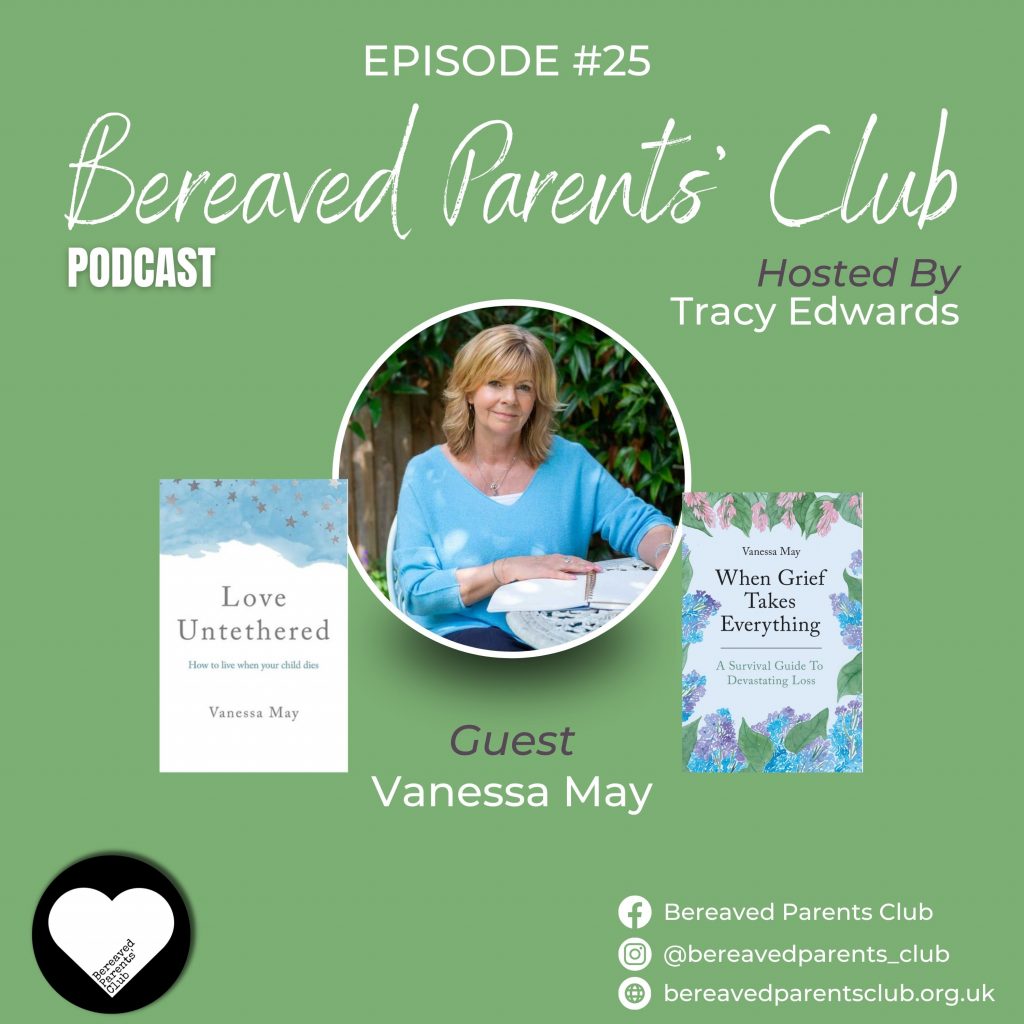
Episode 25: Love untethered, navigating devastating loss and continuing bonds
This episode is dedicated to Harry ♥ and remembering Harry's Dad and Grandad
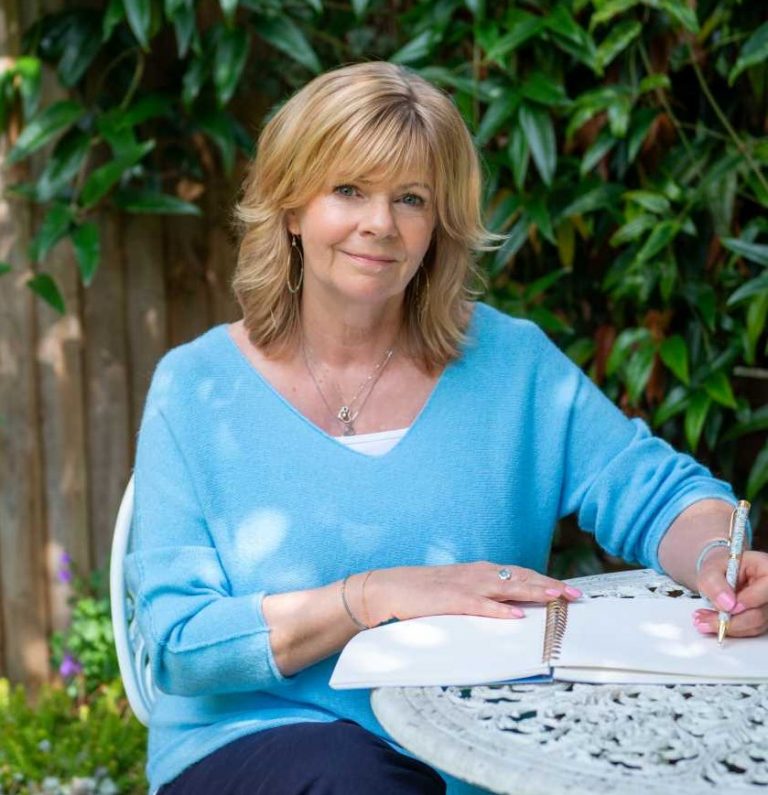
Episode Guest -Vanessa May
Vanessa May is an author, holistic grief coach and certified grief educator. She is also a nutritional therapist, wellbeing coach and spiritual life coach.
Vanessa’s experience of grief and trauma after the loss of her son and husband means she is able to guide others who are going through a similar experience with heartfelt compassion, as well as being in a position to provide professional advice and support.
Vanessa is the author of:
‘Love Untethered: How to Live When Your Child Dies’
When Grief Takes Everything: A Survival Guide to Devastating Loss’
Both are available from Amazon (click links above) and The Compassionate Friends bookshop and library.
“I hope that my books might help others who have suffered devastating loss and that they will be able to relate to my story and find some of the advice offered to be of benefit. I hope too that my books help to raise awareness about the true nature of deep grief so that those who are grieving are always given the compassion and understanding they need.”
Summary:
In this podcast we chat with Vanessa May, a bereaved parent, author, grief and spiritualist life coach about supporting bereaved parents and her books *Love Untethered: ‘How to Live When Your Child Dies’ and ‘When Grief Takes Everything: A Survival Guide to Devastating Loss’. We discuss her son Harry, the shock of his death, and how writing became a way for Vanessa to process her grief.
We also talk about the physical effects of grief and trauma, including sleep, digestion, anxiety, and nervous system dysregulation, as well as the value of self-care, breathwork, journaling, nature, and support from other bereaved parents. Vanessa reflects on continuing bonds, spiritual beliefs, signs, and the comfort she found in research about mothers carrying cells from their children.
Finally, we discuss Vanessa’s later losses, including her husband of 30 years and her father, and how these experiences shaped her understanding of complex grief and trauma and how she wrote her third book during this time. Vanessa speaks about taking things one day at a time, finding small pleasures, and accepting that grief changes rather than ends.
Resources:
Holistic Grief Support: https://wellbeingandnutrition.co.uk
Author Website: http://www.vanessamay.co.uk
Instagram: may.wellbeing.griefsupport
Facebook: https://www.facebook.com/holisticgriefsupport
Marfan Syndrome: https://www.marfantrust.org/pages/15-marfan-syndrome
Follow us on:
Episode 25 Transcript:
Love untethered, navigating devastating loss and continuing bonds with Vanessa May
Today we are so delighted to have the opportunity of talking with Vanessa May, mum, author, grief coach and certified grief educator. Vanessa is a Bantz registered nutritional therapist, wellbeing coach and spiritual life coach. Vanessa has written three books, including Love Untethered, written after her son Harry died, and more recently, When Grief Takes Everything. Welcome Vanessa.
[1:34] Thank you, it’s lovely to be here.
[1:37] And i just wondered if you would like to share your story of Harry and how your first book love untethered began and what this book covers
[1:47] Yeah so my lovely Harry he was 24 when he died he was just a gorgeous soul he had a big heart he was kind uh he gave the best hugs, he was uh free spirit and he was a bit of a rebel you know he gave us a hard time in his teenage years he wasn’t an angel, but he was just lovely and leading up to his death he just moved into uh his own place, and he’d not been very well he’d been suffering a lot with crippling migraines insomnia, allergies he just wasn’t very well um but still we didn’t these think these things were relevant um until we found him, and then like everybody listening our world went into freefall and we just everything changed overnight, and so yes we it was considered an unexplained death uh.
[3:00] In the end, we discovered he had been self-medicating, but we also found out he most likely had something called Marfan syndrome, which affects the heart and the lungs and tends to, he was very tall. He was six foot four, very, very thin, very long fingers and toes. And those are the signs. But we weren’t aware. And unfortunately, it wasn’t investigated. did so but we spoke to somebody from the marfan society and they said yes it sounds very much like it’s what he probably had so yeah, i i then just felt i should find a way to make sense of this, and it was my quest dreamy very soon after we lost him i just felt well he must be somewhere he’s not in the shell his body so where is he do I need to find him, um and you know I think sometimes we do go a bit mad in in grief and I, very much was just trying to find ways to help myself understand why this had happened to us and why this had happened to Harry.
[4:20] And so i found that i did go to a counselor early on and it wasn’t very helpful, so i decided to start writing and i wasn’t writing a book initially i was just, using it as therapy and it was cathartic to just put it all down on the page, and then gradually it just started turning in into a book that i was sort of writing in real time.
[4:45] So that turned into my first book, Love Untethered, How to Live When Your Child Dies. And because my background was as a nutritional therapist and a well-being coach, and because I was doing so much reading, my body was just falling apart. I couldn’t sleep, I couldn’t eat, had all kinds of symptoms, racing heart, shaking. So that to me as a nutritional therapist, I was going, wow, this is trauma. This is what trauma has done to my body. I thought, well, I’ll write about it because I couldn’t find much information on it. This was years ago. I think that probably is a bit more now. So I was writing about the effects grief had on my body and then I sort of.
[5:30] Because the second part of the book is basically a self-help section where I offer what helped me, what I discovered from my reading and research, so that I could pass on what I was learning, and what might help others. So that’s what I did in the first year after losing Harry. And I think it also during that time and writing the book and thinking I don’t think I can go back to being a nutritional therapist helping people with their IBS, trivial things like that when this enormous thing has happened so I started to think well I’d already done some bereavement coaching as part of my course and I thought do you know what, this seems a natural thing to go into and I can help people with their physical symptoms that those two things were so very early on i was trying to find, a way through this later on it’s slightly more unraveled as i’ll probably talk about but but at stage i was like right okay let’s let’s find how can i use this for good, in between i was falling apart all over the place i mean i was a mess obviously but i was at the same time trying to use these things to propel me forward.
[6:48] And thinking that formulating this idea that helping others would also help me and I could use and make Cherie’s loss have some kind of meaning, so that’s that’s the first year it did be.
[7:05] All that in the first year, gosh
[7:08] Yeah.
[7:10] And you’d never written a book before, or did you do a lot of writing?
[7:14] Well, yeah, I was doing blog posts on my website, but no. So it just sort of carried on, and yeah, and then I managed to get a publishing. And then I was asked to write a book for practitioners about how to support their grieving clients. So that was a bit of a sort of, you know, and I thought, yeah, because I then felt people don’t understand about grief. They don’t understand what it does to the body, what it does. Dust mind body and soul and i felt you know grief is a whole being experience affects every bit of us so i was quite passionate about doing.
[7:53] No that’s amazing you’re applying your experience aren’t you to help other practitioners have greater understanding which is just so important isn’t it you know i met quite a lot of breed parents so i think It depends, doesn’t it, on who? I mean, it’s a very personal experience, isn’t it, having therapy? But also, I think it’s a very difficult one when you’re dealing with a loss like this as well.
[8:18] Yeah. Yes, well, that’s the other thing I felt. I tried a trauma therapist, did bereavement counts, and I just didn’t find it at all helpful. And, I just felt, well, you can’t possibly get this. And I know that some people do find good therapists and counselors. So that’s fantastic. But I also was, you know, along the way, I was meeting people who’d had bad experiences and hadn’t find the right support. So that’s the other thing that made me think, well, I’ll be that person. I’m going to get your loss, you know. And later on, I did the David Kessler’s Grief Educator course. So that’s my job now, really, is helping grieving people, mainly bereaved parents. And I call myself a holistic grief coach because I do look at the mind, body and the spirit. Because some people also feel with cancers, if they’re getting signs or they have spiritual belief, they feel that it’s not always well received or they’re not encouraged to talk about it. So I get a lot of people who want to talk about the signs they get. Not everyone. No. But some. Yeah. So how grief impacts physical, mental, and spiritual body. Yeah.
[9:39] Yeah.
[9:40] Okay.
[9:42] So I wondered if you would talk more on how grief impacts the physical, mental, and spiritual bodies you mentioned before, and how the trauma of losing a child, you know, can further impact parents’ immune system. If you could talk a little bit more about that and some of the symptoms that this may bring on.
[10:00] Yeah. Well, I think I was certainly diagnosed with PTSD. I think a lot of bereaved parents do suffer from some degree of PTSD. Not everyone, but a lot of us because the shock is, particularly if it’s a sudden loss, obviously we know some bereaved parents lose children to illnesses. That’s a whole other thing. That’s extended stress and trauma over a period of time. So both are very traumatic um my experience was obviously a sudden loss and and, my body just started malfunctioning basically i think the main thing because i i already understood about nervous system dysregulation, so the nervous system often gets stuck in fight or flight after a shock the trauma . And the whole body then goes into a sort of state of high alert, waiting for the next event to happen. And your nervous system is just trying to keep you safe by keeping you alert. But of course, that means you don’t sleep.
[11:14] When we go into fight flight, that’s the part of the nervous system that dominates over rest and digest which is why we don’t sleep and why sometimes people get a lot of digestive issues, because the body’s prioritizing you staying alert and being in fight or flight, and so yeah and you can get flashbacks you can get brain fog obviously you get very tired uh, you lose your appetite later on you may make up for that by eating too much all these things your body’s had such an enormous shock, and and so what really is happening in the body is that inflammation increases, so that means the immune system can malfunction so.
[12:07] Now to sell you the level that this is why when you initially at first you don’t, looking after yourself, eating well, so that your body then stabilizes again because the inflammation is increasing in your body. When I was doing my second book, I had to find lots of research, and there was an awful lot of research I found about how.
[12:32] We’re more likely to get cancer, which I did, actually, in the second year of grief. And, yeah, the greater the levels of inflammation, the more likely you are to get cancer. And I don’t say this to scare people because if it doesn’t happen to everyone, it really doesn’t. It happens to some of us. It happened to me and I knew all about what grief was doing to my body. But nobody, everyone’s different. So I just say this to really get the message across, to look after yourself the best you can. Because often people don’t eat well, they drink too much. We know why and we understand it. But you know, then there’s also broken heart syndrome, which a lot of us probably have some degree of broken heart syndrome. And that’s a very real medical condition. And when you see a scan of somebody who has broken heart syndrome, it looks very like heart disease. Usually when the grief starts to sort of calm down a bit, then the heart starts to heal. But, yeah, I found all this research, one piece of research, I think it was in the New York Times, that said the damage done to the hearts of parents who lost children up to the age of 29, the risk of heart attack, in the first week after the loss of their child was assessed to be triple the rate of people who’d not lost a child. That’s pretty shocking.
[14:01] Gosh, yes.
[14:02] But it doesn’t happen to all of us. But it can happen. And I think I also share this so that people understand, you know, this is really tough for us. What this does to us is huge. And when just talking about the physical, we know about the emotional, you know, and how that’s so painful, the emotional pain we feel. And then the spiritual aspect which can be why why has this happened trying to make sense of it what’s you know what’s, Why me and not somebody else? Why anyone? And there’s so many questions, I think. It sort of wakes us up to sometimes looking at a bigger picture. What’s life about? Does the soul live on? Where’s my child’s soul? And some people don’t feel that and some people do. So it’s enormous. It’s enormous.
[15:13] It’s huge isn’t it I remember in the early days I just I thought that my heart would burst I just remember sort of having all these pains going down my body I think I found it very traumatic going to bed at night because I went to bed at night and I got up the following morning and I found my son dead so that was sort of a trauma in itself the fact that I went to bed yeah um and i i think one of the things for me was during covid this was separate um thing really i did quite a lot of mindfulness because of what happened you know when covid came and all the uncertainties and i was going through a divorce and i was dealing with George’s depression and trying to support him i started breathing and that’s what i start was doing every night i was counting i was breathing i was doing all the techniques that i’d learned and that really got me through because looking back I mean I still do it now if I’m nervous but I don’t do it like I was religiously having to do it all the time because I was just I don’t know the anxiety that came over me I didn’t want to go to bed because I just couldn’t cope with the anxiety that it brought but yeah I found that doing that really helped me you know a big believer in in sort of there’s lots of different things techniques isn’t there there’s all sorts of EFT there’s lots of things and whatever helps you.
[16:36] It’s good to do isn’t it it’s just so important like you said it’s just looking after so many different things and i didn’t drink either because i felt that if i did drink you know i would stop i hear that so i didn’t have any alcohol in the house and i didn’t touch a drink really for i don’t know
[16:57] A long time i also knew that george would be really not happy with me if i did that because he was you know he was struggling his own mental health he was a big believer in therapy and he’s a big believer in things like that and he would have been really cross with me so yeah but it’s so it’s so difficult isn’t it because you just want to take the pain away so it’s so hard and that’s how you know why it happens as well because you know people just want to numb that pain don’t they as well so it’s very complicated it’s
[17:28] Very complicated and I think breath work you mentioned is one of the best things you can do to calm the nervous system, because anxiety it’s it’s that c.s lewis quote isn’t it why does grief feel so like fear because you do feel it does you feel like you’re in fear, and that anxiety and you’re so on high alert so just calming the anxiety with breath work one of the best things you can do i think absolutely the best things you can do.
[18:57] And you mentioned in your book as well, the sort of second part of the book is like a toolkit.
[18:03] Yeah, so I thought I’d just take everything I already knew and all the things I was learning and offer them to other people and sort of say, pick and choose what might help. This helped me, this wasn’t so great. So it’s very eclectic. It’s things from like Breathwork. I found a brilliant grief yoga 20 minutes youtube video i still do that i recommend, in the resources section there are books podcasts lots of suggestions but yeah things like eft havening, all kinds of things really that that just journaling so that goes from physical things to ways to process the grief and just get it out somatic work, yeah and and everyone needs to find their own way because one thing worked for one person and not another so it’s yeah I I.
[18:58] I call it sort of a basket of resources and suggest everyone puts in, well, I like yoga, I like breath work, but I don’t like swimming, but I do like that. And you just find your own little, because grief makes you feel very out of control. We have no control over what happened. So sometimes if we can get a little bit of control and go, right, I’m going to have a routine where I do breath work in the morning. I’m going to eat a decent breakfast. I’m going to go for a walk Nature, of course, incredibly healing. And just get your own little basket of resources going, you know, or watch your favorite podcast or go to the Compassionate Friends. Find other bereaved parents. So helpful to find your new tribe. Because friendships I hear about a lot in sessions. Friends who let you down, who are there for a bit and then can’t keep it up. So finding your new tribe is quite important. So that can go in the basket resources.
[20:00] Oh definitely yeah it’s just understanding isn’t it, it’s common understanding I suppose in some ways I found that by finding other bereaved parents and having friendships with People who, you know, we share a similar experience, it’s not having to wear that mask, is it? It’s just being able to be and then there’s no pressure to try and fit in with, you know, maybe what your friend circle is doing because you just feel so out of sorts, don’t you? You just don’t feel like you belong in that world. It’s strange, isn’t it? There’s lots of different feelings.
[20:33] I think you’re right. You feel like, you know, you’re in a separate universe now. You’ve gone to another planet and you can go back occasionally to pop over and see people but really that’s not your life anymore so finding people where like you say you don’t have to wear a mask be yourself with them, and they get it is very much i think a positive part of of healing.
[20:57] Yes it is and you mentioned before about sort of when you first lost Harry, about where Harry’s gone. And you mentioned before about the spiritual side. And in your book as well, you cover continuing bonds. I just wonder if you would sort of talk a bit more about what that means to you, Vanessa, personally, and how you continue bonds with Harry.
[21:19] Yeah, well, continuing bonds is a theory that I think, whether you have a spiritual belief or not, it doesn’t matter because you’re continuing your bond, with your child or whoever you’ve lost because there’s that expression, death ends a life, not a relationship. So you still have a relationship with George. I still have one with Harry. It’s ongoing. If you have a spiritual belief, then you may feel them around you. You may believe that you may chat to them. If you don’t, you still continue your bond because you’ll think of your memories you’ll tune into them you’ll still maybe talk to them you’ll maybe just going to the grave leaving flowers, getting together with their friends whatever it may be you continue the bond you could even say their name we know that expression um, the things you can do you know it’s also part of post-traumatic growth as opposed to post-traumatic stress post-traumatic growth, is you know we’re still going to grieve it’s still going to be very painful but we can look at what we can do to continue our bond, helping other people, you know that kind of thing in some way so you’re honoring your child.
[22:38] But it’s, yeah, it can look like whatever you want it to look like. Because we’re never going to forget that. We think about it. When people say in a normal loss, oh, there’s not a day goes by when I don’t think about them. I always think bereaved parents are probably laughing at that, going, a day? A minute? You know, because we think about them all the time. That’s a weird continuum of bond. And David Kessler always says, the goal is to remember more with love than pay. So if anyone’s listening and they’re in early grief eventually you do you it’s still painful but you do remember with love love’s enormous the love grows love doesn’t go anywhere it grows.
[23:20] Yeah. And on the spiritual side as well, because you do spiritual life coaching, I just wonder if you wanted to talk about that and how you connect with your loved ones.
[23:31] Yeah. Well, I’m aware it’s not for everyone, but certainly it’s one of the things that’s helped me. And it is part of my continuing bond with Harry that I speak to him, I connect him, I feel him, I look for signs. I’ve been to mediums, which I always caution. I have recommended mediums in my book be very careful but you know it can be helpful to many people, because often they say it’s a spiritual part of counseling that’s that’s sort of missing and that’s why people turn to mediums, and i just think they say 75 percent of bereaved parents believe they’ve had a sign from their child that’s high, so yeah but of course I respect whatever anyone’s beneath is mine is, that Harry’s with me that his soul lives on I feel him I feel him around me not all the time we have had signs which I wrote about in the book uh and, yeah it’s making sense of what’s happened. They say that the souls that don’t come in for long are older souls.
[24:47] Yes. Yeah. I listened to that in one of your interviews and that sort of resonated with me as well because everybody that knew George sort of said he was an old soul in a young body.
[25:00] Yeah. And they often have certain characteristics. They’re often very kind. They’re often a bit different. these are and now i hear a lot of stories from breed mothers i’m working with but and the ones i’ve read about and there’s an organization called helping parents heal which, they have videos talking about the afterlife basically and that yeah they usually if, want to go along with this idea um that their older souls they’ve come in to teach us we’ve done many lifetimes with them this is just one of many lifetimes which, and they’ve come to teach us, and they do teach us not in ways we particularly want to be taught but they do and we probably do get wiser through our loss.
[25:51] You know that’s one thing that comes out of it we feel wiser and we maybe look at the bigger picture, and we’re not so head down in our material anymore, you know lots of us change in that respect anyway i think i know i did i just started seeing the bigger picture and going oh and the other thing is bereaved parents often lose their fear of death, there’s no other group There’s no other group. I talk to widows, people who’ve lost parents. They still have their fear of death. It’s normal. Bereaved parents, I won’t speak for everyone, but a lot of us go, well, you know, either I’ll die and I’ll be with them, which will be fantastic. Think of the reunion. Or I’ll be out of pain. So you kind of go, it’s a bit of a win-win, I always think.
[26:43] Yeah. But I think for myself, because George was my only child as well, I think I’ve lost the fear of anything and everything. It’s very strange. It’s really strange. The things that affect me before, in my head now, I think, well, you know, that really doesn’t matter. It’s not that it doesn’t matter. I’ll still do my best. In relation to what I’ve experienced and to relation to the loss I’ve had, then it’s minimal. Whereas before, I would have been very anxious, kept me up all night worrying about it the day before. It’s just very, very strange. So it’s what matters, isn’t it? You look at things that matter and you look at things that maybe, you know, what is important, what isn’t important. If it’s trivial, then it doesn’t matter. Whereas before, you can get hung up on the little things, can’t you?
[27:32] Yeah, absolutely.
[27:34] And I’ve heard lots of excerpts out of your book in my local TCF meeting. So I know your books are used a lot, Vanessa. And I’ve heard a lot of parents talk about your books as well. I know they’ve got a lot out of them. One of the things that resonated with myself, I think very early on as well, it just was something that I held on to and it sort of gave me a little bit of comfort. I know you talk in your book about the mother continuing with carrying the cells of a child.
[28:00] Yeah. Yes, I found that quote early on and I found it so comforting. So it’s called fetal microchimerism. I’m pronouncing it right. And basically mothers and fetuses exchange DNA in cells. And the research has shown that some of these cells live in our blood and bones for decades. So to just know that we’re carrying our children with us, that’s another form of a continuing bond in my book.
[28:28] Oh, yes, definitely.
[28:29] You know, that we are carrying our children with us. You know, we have their cells. That’s so comforting. You know, I mean, obviously we’d want them physically here, in the real world, but it’s a little comfort. So, yeah.
[28:45] Yeah, it is. It’s amazing. I had no idea of that. And like I say, it was read out. And I have heard it read out a few times. And I know it does bring comfort. It just makes a little difference just to know that, I think. Yeah.
[29:00] Yeah.
[29:02] And I just wondered if you would go on to talk about your third book, Grief Takes Everything, A Survival Guide to Devastating Loss, and sort of how you came to write this third book.
[29:17] Yeah, so this is where my story gets kind of worse. So a couple of years after we lost Harry firstly i should say that my husband was a rock and allowed me to fall apart and held me up literally sometimes in the first couple of years, after we lost Harry um, but that it was it was during covid, um my dad who was very elderly First of all, he died, which was not unexpected. But three weeks later, my husband died.
[29:59] So, and we all were ill with COVID. So I felt incapacitated by physically. And then, I mean, I’ve written about it when grief takes everything, but the horror of being on a COVID ward, we weren’t allowed to see until the very end. At least it was that stage where you could go in, but we had the full you know pp equipment stuff it was it was a second nightmare for me, and and it was i couldn’t believe it i couldn’t believe this was happening again, and i couldn’t i couldn’t imagine i was going to manage without him because he literally was doing everything um and, he was amazing really so to lose him was, I just thought, yeah, I’m not going to survive this. I’m not going to survive this. I’d also had cancer as well the year before. And he was so supportive through that. Yeah, and then I was very jealous because he was going to be with Harry.
[31:05] And, you know, we have a daughter, so obviously that’s what can be here. But really, it was pushing me to my limits. And I was ill. I was ill really badly. I’m talking about inflammation in the body again. So I thought, okay. And I think the difference being a widow is you’re doing a lot of practical stuff. You know, you have to take the bins out. You have to mow the lawn. You have to work out how to, you know, I didn’t know who the insurance, content insurance was with practicalities. You know, in a couple, you both have your jobs. So, you know, I’d just been grieving, Harry, obviously ongoing. And then suddenly I had to take on all the practicalities. And he had written a will, but he didn’t think he was going to die. So nothing. And he’s got a whole life. You know, when you lose a young person.
[32:00] Sadly, there’s less to sort out in a way. But when you lose a part and there’s an awful lot, I just seem to be filling out tax returns, filling out. It just, I thought I was in hell. I thought I was in Saline. I was. Well, one of the things I did, well, I’ll write about it then. And I thought, I’ve got so much knowledge now about Greece. And what does it feel like to have a second major, major loss? And obviously, I lost my dad and my husband within three. Weeks what does that feel like there will i won’t be the only person who goes through this, and and so i just i yeah so i wrote a sequel basically to love untethered yeah and so the the first part is my story i don’t sugarcoat it.
[32:53] Because it was hell, And the third part is divided into mind, body, and spirit. So again, it’s self-help, but I learned so much more. And now I was working as a holistic grief coach, and I was doing the grief educator course. I had more to offer the reader. You know, I had more to offer the reader. So yeah, it was my therapy again, but it was also, I’ll have to just use this to help others because that’s what I did last time. I mean, it’s a formula I’ve now got, so I’ll try again. But it was, you know, it was hell. It really was. Because I’d lost my sounding board, my companion, my co-parent. Yeah, it wasn’t.
[33:42] Incredible a lot to go through as well. Yeah. I mean, it’s, especially in that time, like you say, as well, just having those restrictions, I mean, it must have been, Just so incredibly, the stress on top of the stress that you were both dealing with as well at the time.
[34:01] I had a lot of EMDR at the time because EMDR hadn’t really worked for me after Harry. And I thought, my nervous system is so dysregulated. I had 22 sessions and it wasn’t easy, but it did help the flashbacks. Because then I had two lots of, so then I was diagnosed with complex PTSD.
[34:21] Yeah, I can completely understand that with all those losses. Your son, your husband and your father in such a short space of time.
[34:30] Gosh.
[34:32] And with this book as well, I’m right in saying that you cover the loss journey of six other women as well.
[34:39] Yeah, so I thought, although it’s a sort of sequel to my story, In Love Untethered, I kind of felt, I just need to broaden this out a bit for the reader. And I just thought it’d be quite nice to share the stories of others. It’s mainly bereaved parents, because they’re the ones that I most knew. and a couple of others. And one was a client, one was somebody who’d read my, book she’d read Love Untethered and she wrote to me. And we formed a sort of friendship, although she didn’t live locally to me. So.
[35:18] And she was really interesting, so I included her. Then there are a few others I sort of met along the way and thought, that would be good. Would you like to share your story? And so really, I think the purpose of that is for people to, because my story is pretty bad, but I wanted other grieving people to go, look at this. This is an example of how you survive this. I mean, I’ve survived this because I’m sitting here today. These six women have survived. And so when you’re grieving, you’re like, how am I going to survive? So we’re all sort of, you know, trying to share our ways of how we’ve survived and how some of the things we might have to offer might help person, you know, reading. So that was the the idea of it was to to get a broader perspective of loss really major loss.
[36:13] Trauma yes i’m sort of going through these additional losses as well did that sort of change your beliefs in how you coach people yeah did that sort of change the way that you do that
[36:26] I think i was already yeah i mean i i don’t just see bereaved mothers but i mainly do so i learned so much from the people i work with and, and what i learn i then sort of share back so they’re helping me to help others, the six women in the book also, inform how i work so i think i would say my practice has deepened i have a lot of my own personal understanding, but working with others meeting other bereaved people i yeah the complexity of how it affects say relationships the body as we talked about but friendships how they change, work, all kinds of things that are major loss inputs. And so I learn from others as well as my own experience and pass that knowledge on to others.
[37:26] And you mentioned about the complex PTSD and in your book as well, you talk about effective healing processes and methods, sort of how you can help with this trauma and this pain. I just wondered if you could share a little bit about that.
[37:44] I think I mentioned EMDR, so that’s probably the most well-known method of coping with trauma. And as I say, I did have 22 sessions after my husband died, and they did help with the flashbacks. I don’t want anyone to think that that will solve their grief, because you’ve still got to grieve the loss. For the trauma, I do sort of separate out the grief and the trauma as being two separate things. But also part of each other but, yeah so the trauma there are more practical things you can do all the things that i’ve already mentioned really somatic work being out in nature walking exercise eft, all these things i mean i write about them all in my book and i give the organizations you can you can find, i think things like saying after trauma i’m safe, i do it with either butterfly um or havening, which is for not on camera i can’t show you but just saying the statement when you’re you’re spiraling into anxiety you just say i’m safe this isn’t so you don’t go back into the trauma because the trauma is not happening now trauma was then.
[39:03] So if you come back into the now and that can be helpful just telling yourself you’re safe over and over until your body hears it.
[39:14] But, you know, the grief has to be gone through. And I think in some ways my writing and thinking I’m going to help others was a bit of a distraction from, you know, facing, I mean, I was facing the pain, losses, but it sort of, I always talk about the being and the doing. So sometimes you just have to be with the grief, be with the loss. And sometimes you have to do something practical, like move your body, like, you know, whatever. So I think the being and the doing is is getting the balance of that is as often what’s needed in our type of lots.
[39:52] Yeah and as the years go by as well I suppose some of this will change I mean it’s a lifelong journey isn’t it it’s not something you’re just suddenly going to be healed from and you’re going to walk away from that that’s not the case it is a lifelong journey So I suppose as the years pass, probably the way that you are and the way that you deal with that probably evolves as well, doesn’t it?
[40:16] Yeah, I mean, they say the grief softens. I think the grief definitely changes. I think, because in early grief, you really just want, I just wanted somebody to say to me, okay, it’s going to get better. And I noticed how people spoke which was when it changes well it softens because that’s the truth of it but I think what complicates it and particularly for me is that my grief is sort of doubly intense and probably.
[40:50] Well, it’s called compound grief because I’m also, you know, I was married for 30-odd years. It’s a long time. I don’t really remember much of my life before I met my husband. So that’s quite another loss to process alongside the worst of all losses, the loss of your child. But it does change. And they say you grow around your grief. You function. You begin to function. You can behave like a normal person. Most of the time but we carry that we carry the the weight of it you know there’s no getting around that we probably want to because it’s our child, i don’t want to not carry the love i have for Harry but as i say if we can start believing that we’ll grieve more with love than pain something to work towards and that feels, better really and and one day at a time, and also going back to the spiritual aspect we’re here on earth school i love the fact that you know i read about this is earth school we’re here to learn certain things we’re here to grow whether we like it or not.
[42:07] That’s a great way of thinking of it actually isn’t it I’d not heard that before earth school.
[42:12] Yeah.
[42:15] Yeah. And… I just wonder if you had anything that you could share. Like, you know, you’ve obviously experienced all that loss and the loss of your husband, like you say, all the years that you were together. I mean, it’s absolutely huge, isn’t it? On top of losing Harry. For anybody else who might be listening, who might recently be bereaved of not only their child, but also their partner or a very close family member, or might be going through anticipated loss through terminal illness currently.
[42:49] I think the anticipation is difficult because we’re all going to lose our parents and we’ve always known we will. But sometimes because of what we’ve experienced with the loss of our child, which is an out-of-order death, even an in-order death, where elderly people die, but it’s still a lot. We know it’s coming and we know what we felt like before. Oh, is it going to feel like that again. So I do go back to the just do today, just do one day at a time. It’s very simple. It’s just probably the wisest thing you can do. And I also very much believe in sort of, this has happened. We can’t fight it. When I’m working with people in early loss, they say things to me like, this wasn’t meant to happen to me. This wasn’t meant to happen to my family. And the longer they stay in that fighting it, the harder it is. And the sooner they can move through to, yeah, but it did happen. I don’t like it. I’ll never like it. But I have to accept it. I have to accept what’s happened. It’s not okay, but I can’t do anything about it. I wasn’t powerful enough to stop it.
[44:08] Sometimes that’s the bargaining, not that I really go in for the five stages of grief, but the bargaining, the kind of, if only I’d done that, I should have done it. I could have changed the course of what’s happened. We’re not powerful. When you can surrender and let go of some of the guilt, that can help. But it takes time. It takes time. it honestly i don’t think it really helps to look too far ahead, just do today and find small pleasures i always say find small pleasures, what gets you up in the morning when you it’s an awful a nice cup of coffee or i’m going to have this or i’m doing that today or, just small pleasures i’m meeting a friend in the park we’re going to go for a nice the sun’s out find small pleasures, because sometimes we have to our world shrinks, and we have to stay there for a while before we can expand out again so just find those small things that you know a pet whatever it is that gives you a little bit of pleasure in amongst the, the terrible thing that’s happened because i do believe we have to acknowledge it, you know a hundred percent this is awful you know when you’re allowed to feel it’s awful.
[45:25] A lot of parents call it glimmers as well, don’t they?
[45:28] Yeah, glimmers.
[45:28] Just something to, like you say, something to hold on to. I find sometimes just going and taking yourself in a lovely garden, you know, go and walk in, you know, a nice garden and just look at things, just appreciate the beauty in things. It just helps ground you as well, doesn’t it?
[45:48] Absolutely. Just sitting in your garden and looking at roses growing or simple pleasures. It sort of concentrates your mind into looking at the beauty of the world and there is that it’s called collateral beauty where you the contrast of the terrible pain you’re in you then look at nature and you go wow, it’s amazing really it’s that contrast between the awfulness and the beauty.
[46:15] Thank you so much vanessa for sharing all your experiences and your expertise and your books as well and we’ll make sure that we have links to everything you’ve talked about and also we’ll have links to your books as well so anybody who might want to read one of your books knows where they can get them from i just have one last question to ask you we always end on this so i just wondered is there anything that you’re grateful for today
[46:45] Well, every day I could say that I’m grateful that I had Harry in my life for 24 years. How lucky was I? He changed. He was my first child. He changed my world. And obviously he changed it again when he left. But those 24 years are precious and they are everything to me. And I am grateful for him. And I feel him around me and I’m grateful that his soul lives on. But the other thing I want to say on a lighter note is I’m very grateful for my cat Ziggy so we had two cats one sadly left us this year but the second one he’s just, so joyful he’s a ragdoll and he talks so I had conversations because I’m living on my own now and he’s my he’s like my best friend, which you know sounds a bit sad but we have these conversations because he’s very chatty so I would say you know pets can be wonderful and I’m very grateful for Ziggy.
[47:46] And it’s a brilliant name as well Ziggy lovely that’s lovely thank you so much for sharing that and thank you so much for spending the time with us today
[47:57] Vanessa oh you’re very welcome it’s been lovely to be here.
[48:03] This episode is dedicated to Harry Harry’s Dad and Harry’s Granddad